
 Image 1 of 1
Handwoven in the high Andes near Ocongate, Peru, by families connected to the Q’ero traditions, communities living in the shadow of the sacred Ausangate Mountain, one of the most revered Apus (mountain spirits) within Andean cosmology.
Widely regarded as descendants of the Inka lineage and keepers of ancient Andean wisdom traditions, the Q’ero people continue to carry weaving, ceremony, and relationship with the mountains as part of daily life.
Within Q’ero tradition, weaving is far more than craft.
It is memory.
Prayer.
Relationship with the land and the Apus.
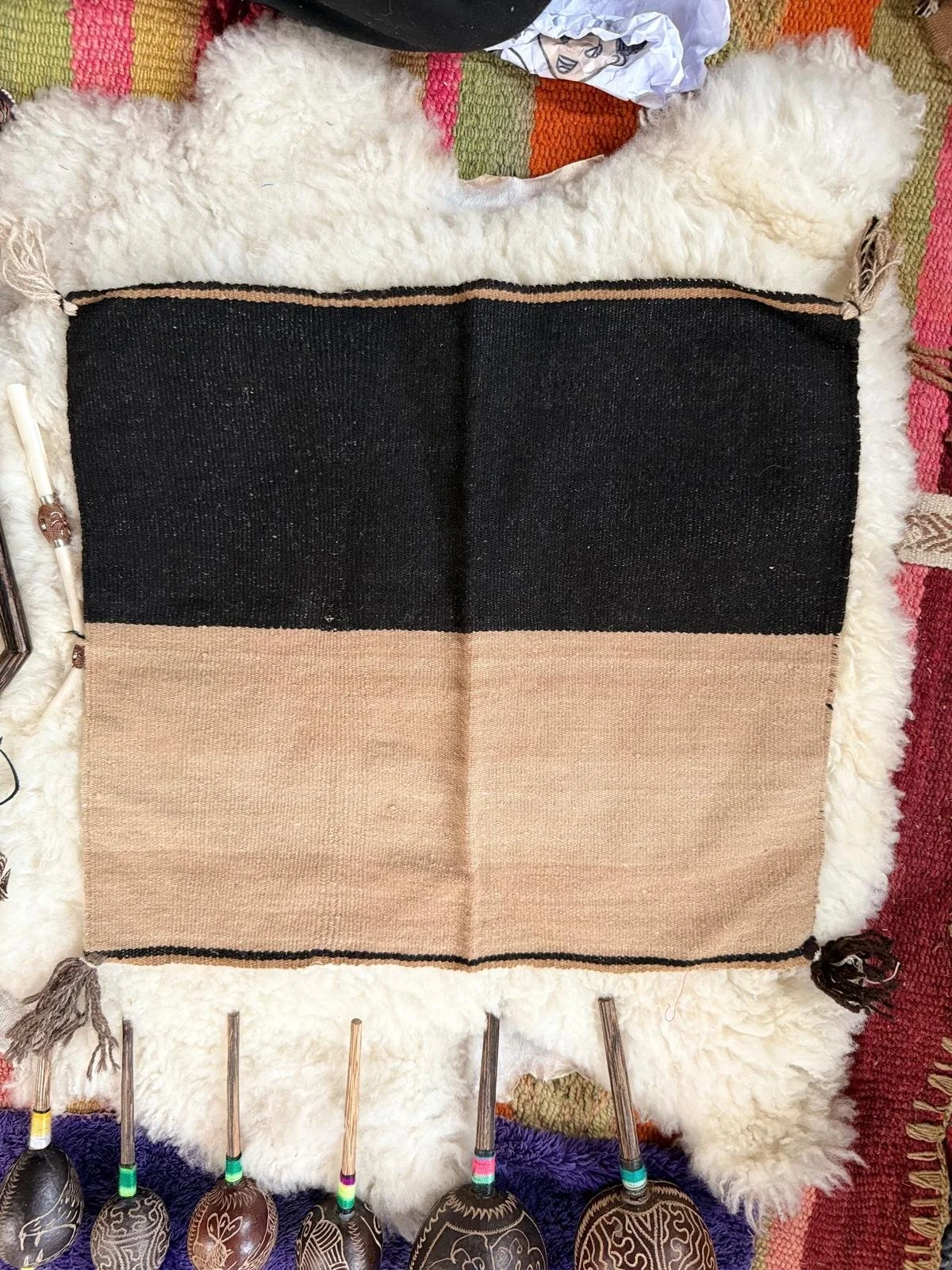
This traditional Unkuna ceremonial cloth expresses the Andean principle of Yanantin, sacred duality and complementary relationship.
Black and white.
Light and shadow.
Feminine and masculine.
Earth and sky.
Not opposing forces…
but energies existing in relationship and balance with one another.
Traditionally, an Unkuna is used to carry sacred items:
Coca leaves
Despacho offerings
Ceremonial tools
Personal medicine objects
It becomes a woven holding space for prayer and intention.
Each piece is handmade slowly from beginning to end.
The wool is gathered traditionally, hand-spun, naturally dyed using plants and seeds from the region, and woven using ancestral techniques carried through generations of Q’ero families.
These textiles are considered among the closest living expressions of traditional Inka weaving methods still alive today.
Beautiful as:
Personal altar or mesa cloth
Despacho base
Sacred carrying cloth
Wall hanging
Ceremonial textile
Meditation or prayer space
These are not decorative imitations.
They are living traditional textiles carrying the spirit, symbolism, and mountain lineage of the Andes.
Handwoven in the high Andes near Ocongate, Peru, by families connected to the Q’ero traditions, communities living in the shadow of the sacred Ausangate Mountain, one of the most revered Apus (mountain spirits) within Andean cosmology.
Widely regarded as descendants of the Inka lineage and keepers of ancient Andean wisdom traditions, the Q’ero people continue to carry weaving, ceremony, and relationship with the mountains as part of daily life.
Within Q’ero tradition, weaving is far more than craft.
It is memory.
Prayer.
Relationship with the land and the Apus.
This traditional Unkuna ceremonial cloth expresses the Andean principle of Yanantin, sacred duality and complementary relationship.
Black and white.
Light and shadow.
Feminine and masculine.
Earth and sky.
Not opposing forces…
but energies existing in relationship and balance with one another.
Traditionally, an Unkuna is used to carry sacred items:
Coca leaves
Despacho offerings
Ceremonial tools
Personal medicine objects
It becomes a woven holding space for prayer and intention.
Each piece is handmade slowly from beginning to end.
The wool is gathered traditionally, hand-spun, naturally dyed using plants and seeds from the region, and woven using ancestral techniques carried through generations of Q’ero families.
These textiles are considered among the closest living expressions of traditional Inka weaving methods still alive today.
Beautiful as:
Personal altar or mesa cloth
Despacho base
Sacred carrying cloth
Wall hanging
Ceremonial textile
Meditation or prayer space
These are not decorative imitations.
They are living traditional textiles carrying the spirit, symbolism, and mountain lineage of the Andes.